

Baseball Toaster was unplugged on February 4, 2009.
Email me at btimmermann@gmail.com
Select a date:
Courtesy of the Library of Congress' American Memory site is the 1910 Spalding Guide:
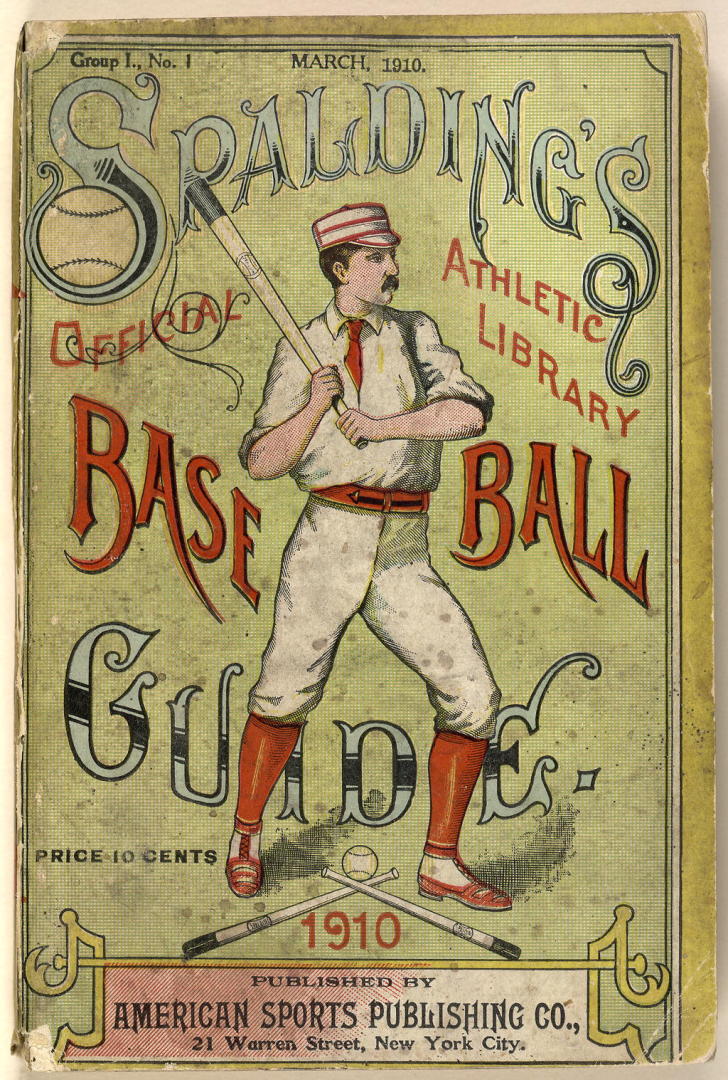
You will need to read the jpegs of the pages here.
Here's a sample:
The more interesting parts are emphasized by me.. 25 J. ED. GRILLO, Washington Post. "No change in the present system of crediting pitchers with victories or charging them with defeats when two or more are used in a game has suggested itself to me which will eliminate the injustices which frequently result under the present system. It is my judgment that when such matters are determined by competent officials the pitchers get a square deal on the whole, and a fairly good idea of their actual performances is to be gained. There is no system which will ever give figures showing the actual value of a pitcher." PAUL W. EATON, Washington Correspondent Sporting Life. "I think that either runs earned by opponents, or base hits by opponents, would be the best measure of pitcher efficiency. Probably the first named is preferable." STEPHEN 0. GRAULEY, Philadelphia Inquirer. "In summary of game give each pitcher's name, the number of men to whom he pitches, the hits and runs made off him, the inning in which he was taken out of the box or entered the game. The mere mentioning of the inning the pitcher either left the game, or entered it, would enable the public by a glance to tell just which pitcher was entitled to the victory and which pitcher should be charged with a defeat." GEORGE E. McLINN, Philadelphia Press. "I most certainly think that Base Ball pitchers are not receiving the proper credit for their work under the present system. I would suggest * that a twirler's work be averaged on the number of strike-outs he has, the number of bases on balls he allows, the number of hits the oppo- nents make off his delivery and the winning or losing of the game be made a secondary consideration. A batter who can hit .300, even though he is on a tail-end club, is not kept down to a .200 average because his * fellow players don't help him win games. Why should a pitcher be made to suffer, in the eyes of the "fans" who peruse the averages, simply because his pitching, no matter how good, cannot win alone? Averages based on the individual work of the twirler would encourage him and he would work twice as hard to win, no matter how bad his support was."
Or the finest onion on their belt.
I think that's just the way the OCR made it come out.
Comment status: comments have been closed. Baseball Toaster is now out of business.